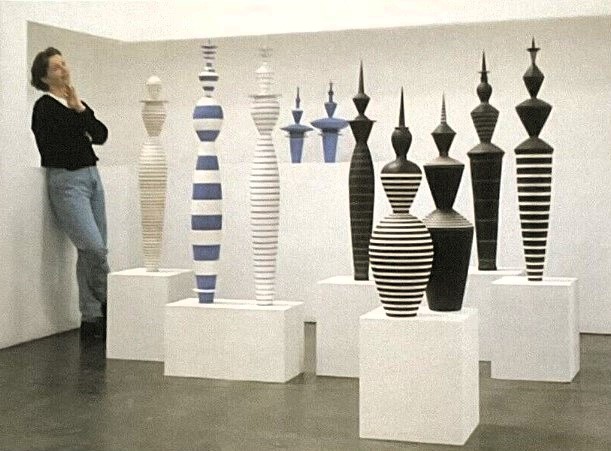
Roseline was a Quebec artist who achieved international success after she moved to the Los Angeles area and became a part of the dynamic West Coast ceramic scene.
Originally from Rimouski, Quebec, Roseline set up her studio, firstly in Venice CA, then Santa Monica CA. Originally trained in Montreal she developed her Post Modern style using functional elements in her sculpture. Her signature black, blue and white linear surfaces on conic and dish elements evolved from “non-functional” vase forms into dynamic statues and hypnotically spinning tops.
Enjoy the article and let others know of its posting.
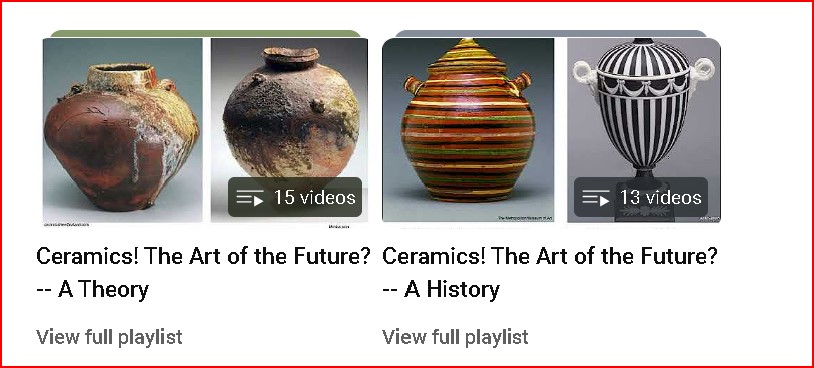
Mathieu: Ceramics! The Art of the Future: A History and A Theory
One of the joys of having a website is that of people sharing their creations, discoveries, and thoughts.
One such is the online book Ceramics! The Art of the Future: A History and A Theory by Paul Mathieu, ceramist, educator and critic, available for FREE online on YOUTUBE, along with 28 related audio/visual presentations at:
“The subtitle “A History and A Theory” clarifies the content. The title “Ceramics! The Art of the Future?” is significant since, throughout this book, a convincing argument is made that Ceramics as an independent and specific art form, is also an archival material and its role in civilization acts as a “memory of humankind”. This is still true today of the ceramics made now, and in the future just as much, and may provide relevancy for contemporary makers and those who appreciate their work.”
His analysis explores world culture, featuring ceramics and pottery throughout time and from all over the world, from the Neolithic to today. Mathieu develops his framework using seven “aesthetics”: the Classical, Flux, Decorative, Narrative, Simulation, Industrial and Material Aesthetics. To complete this analysis, seven themes are further explored, and they are: Food, Shelter, Hygiene, Text, the Figure, Sex and Death.
While being comprehensive, it is not meant to be a complete history of the field, rather, it offers a broad and inclusive overview, permitting the reader to expand their comprehension and appreciation of ceramics and apply this expanded knowledge for the furthering of their own needs and interests.
Mathieu’s writings are significant not only in their historical context but also in the much needed area of ceramic critical analysis for artists, educators, writers and collectors.
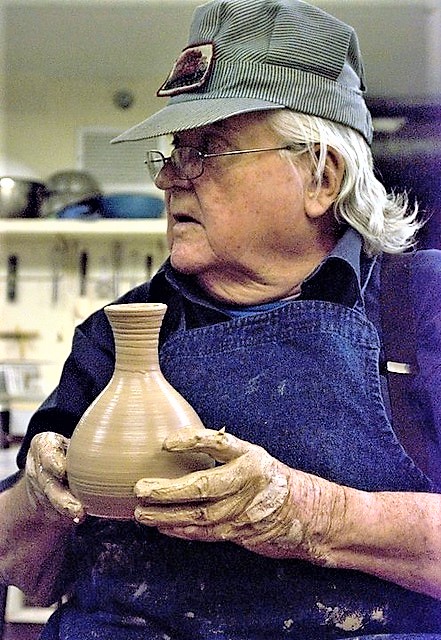
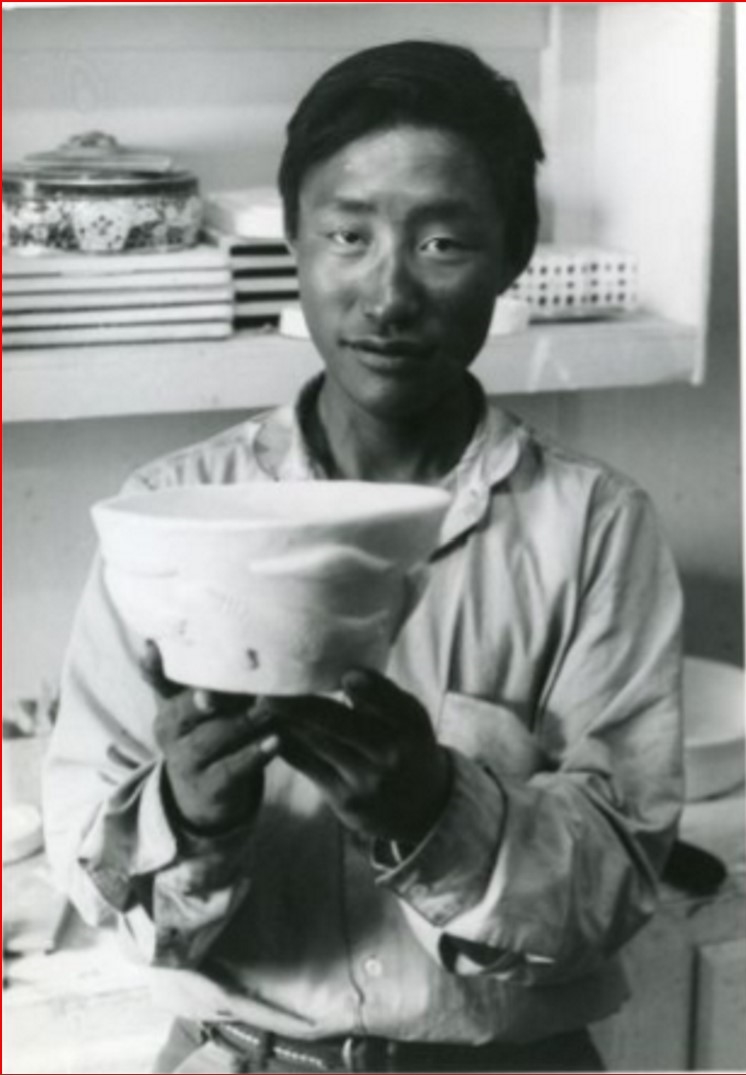
Dean Mullavey. nd, recent. Photo source: Kevin Mullavey
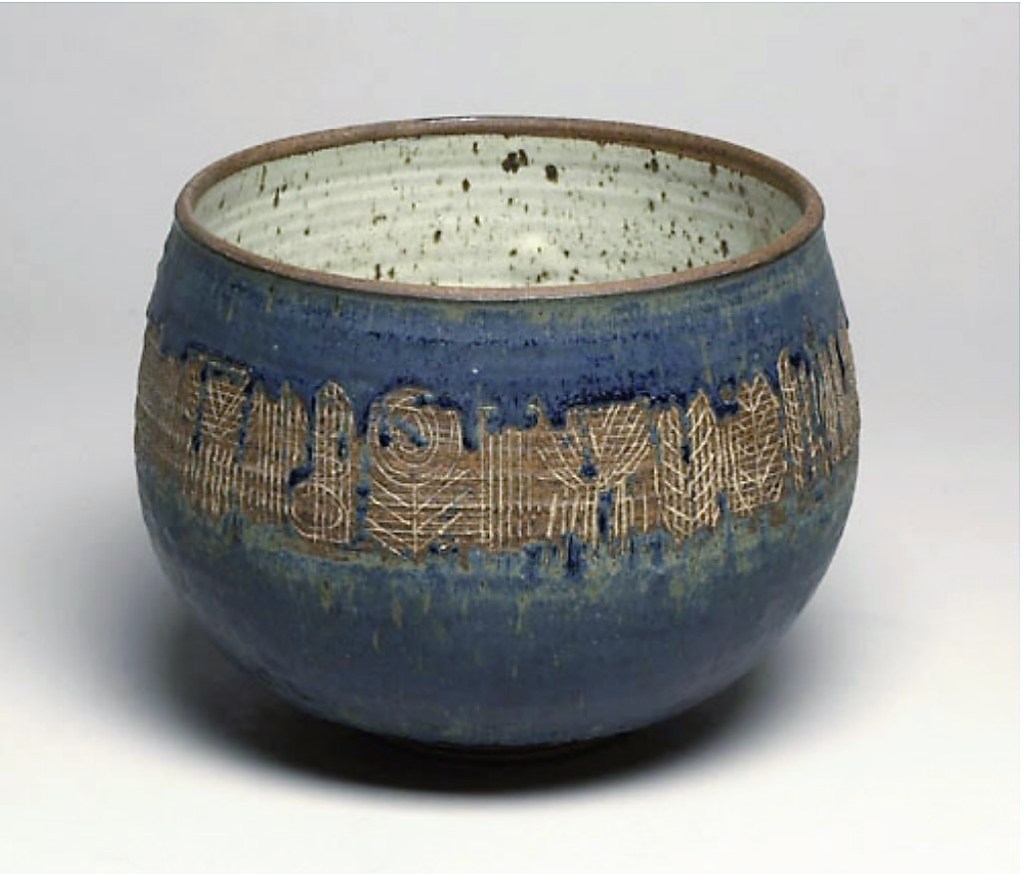
Dean Mullavey. c. 1967. Large blue vase with incised decoration. Stoneware and sgraffito 21.9 cm x 29 cm.
Photo:Musée National des beaux-arts du Québec.
I have posted a page on Dean Mullavey. Dean was an artist and teacher, much respected and admired for his work and approach to ceramics.
Originally from New England, Dean made Quebec his home base in the mid-1960s: La Poterie in North Hatley, and the college in nearby Lennoxville were part of an active art scene in Quebec. Well travelled and well connected with major ceramists Dean became an inspiration to many Quebec and other Canadian potters. His works are much sought after by collectors.
Enjoy the article and let others know of its posting
Judy Chartrand. In Memory of Those No Longer With Us, 2022, Low fire paper clay, underglaze, glaze 11.4 x 33 cm. Photo: Judy Chartrand.
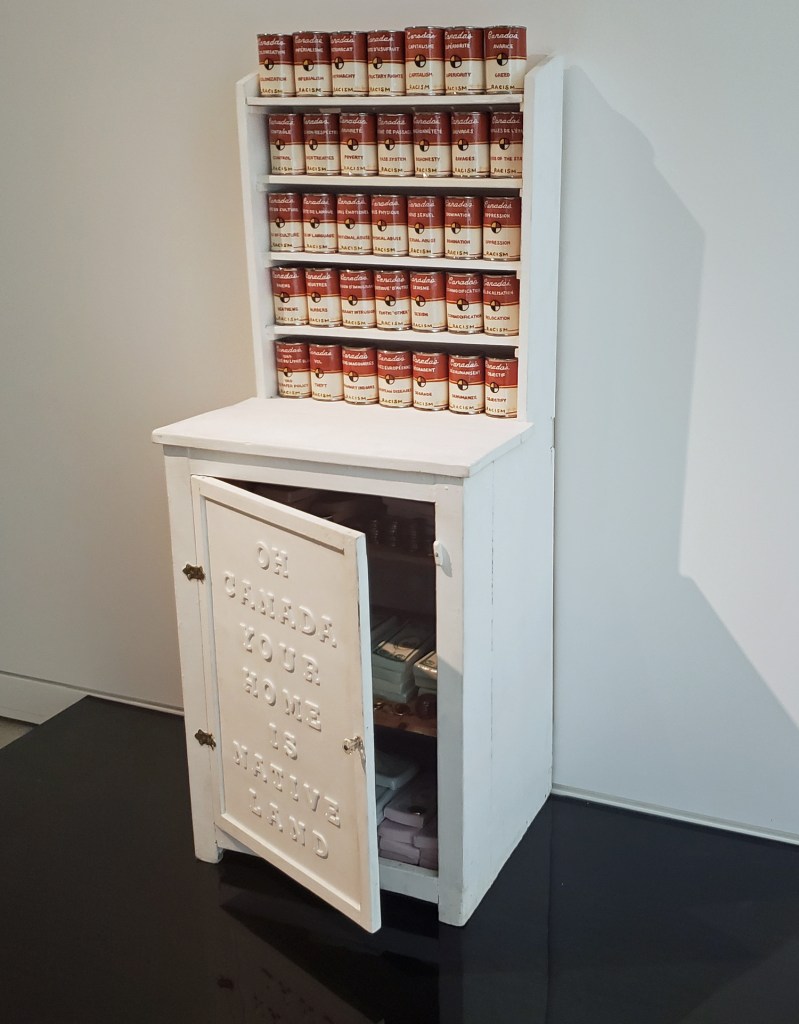
Judy Chartrand. Cupboard of Contention (2001) Slip-cast, low-fire clay, underglaze, glaze, lustre, antique cupboard, wooden letters, paint. 142.3 x 57.2 x 45.7 cm. Rennie Collection. Photo: Alina Ilyasova.
Vancouver indigenous artist, Judy Chartrand, uses her art to give voice to her experience and observations of the indigenous experience in North America.
In an article contributed by noted writer, educator and artist, Amy Gogarty, we can see not only the art but also “hear” the passion underlying Chartrand’s works.
Judy’s titles can have a wicked wit that expose deeper actual pain. And yet she can then take joy in natures’ colours and forms as she incorporates images and styles of other indigenous cultures. She has also created architectural scale works that move her beyond the museum and collector orbits.
Rankin Inlet. The name, the location, hardly register for many as a site for ceramic work. Yet, for over a dozen years from the mid 1960s to the mid 1970s it was the focal point for Inuit experimentation and development in clay. The literature and documentation on the period and work are voluminous. But much of it is in academic theses, government archives and arctic related journals. So much there and so many gaps still to be filled in the stories of modern Canadian ceramics.
This article, Inuit Ceramics From Rankin Inlet (Kangirlliniq), is the first in a number of indigenous themed articles planned for over the next few years. Hopefully this article will help fill in those gaps.
May 2022 give you good health and success. Thank you to all who connected with us in 2021, sharing thoughts and support.
For this year expect new pages on such topics as Rankin Inlet Ceramics – the Early Years, Dean Mullavey, Roseline Delisle, and Luke Lindoe; and updated pages on artists such as Ernst and Alma Lorenzen. And more.
Successful firings to artists, and success in finding that special piece for collectors.
Good things continue to come out of Atlantic Canada and Goose Lane Editions that add more professional insight, and documentation to the story of studio ceramics in the region. The latest is a heavily colour-illustrated catalogue for the retrospective exhibition, Walter Ostrom: Good Earth: The Pots and Passion of Walter Ostrom. Although the exhibition ran from October 2020 to March 2021 at the Art Gallery of Nova Scotia the more recent catalogue is a solid and much needed history of Ostrom’s life, work, and philosophy.
The exhibition was curated by Shannon Parker with Judy Hollenbach and Sandra Alfody.
Although most know of Ostrom’s work through his earthenware, the catalogue gives details of his artistic development, his experimentation in clays, glazes, new forms. and even his glance into 3D software. What comes across is passion: passion for the medium; passion for never staying in one place artistically; and a passion that he communicated to his students.
The title is a play on several levels ranging from Ostrom’s love of earthenware and his love of plants and nature arising from the earth.
There are also explorations of his need to break free from limitations and conventions be they of the political or art vs craft discussion.
The catalogue consists of fourteen sections, eleven of which contain the meat of the Ostrom story, with eight contributing authors.
Walter Ostrom by Paul Greenhalgh provides a short overview of Ostrom in a broad historical context but he sets the stage with this summary”
” Artist, teacher, historian: Walter Ostrom is a force of nature, a whirlwind of energy, and a vital contributor to Canadian and international art.”
Ceramics at the Edge by Alan Elder touches on the revolutionary, almost anarchistic early leanings of Ostrom. This shifts into an overview of the development of crafts in the early ’60s looking at the changes in attitude in professional crafts the and the establishment of educational centres and schools, and the influence of regionalism in Canada. The chapter shifts into an analysis of NSCAD, its development, reorientation and reprogramming to newer theories about craft and design.
History as Content/Tradition as Idea. The Art of Walter Ostrom by Ray Cronin looks at Ostrom’s artistically disruptive changes in his art that happened at NSCAD under Garry Kennedy, and the explorations that Ostrom took in conceptual art in concert with an international array of artists and ceramists. This would lead to explorations in post modernism as he combines the shapes and motifs of widely different cultures into one piece: for example Chinese and Greek combinations.
Walter Ostrom—Master of Earnestness, Prince of Curiosity by Mary Boyd touches on the influence of other cultures and personalities on Ostrom and delves into extensive detail on Ostrom’s love of and influence on modern Chinese ceramics, with visits to China including Jingdezhen. Ostrom was also an international influencer in a tremendous cross fertilization between his Australian and many Chinese associates and fellow potters, who themselves became major leaders in ceramic production and teaching.
Walter Ostrom’s Passionate Pedagogy by Julie Hollenbach not only deals with Ostrom’s philosophy and again, his love of Chinese and Japanese art and history, but also his investigations with items such as Lantz clay, particularly from the student perspective.
His teaching style was filled often with humor and eccentricity but also felt relaxing. The studio was not a tight rigid or serious place. Ostrom’s students universally talk of the excitement of his teachings:
“Along with his championing the use of Lantz clay, Walter also pushed his students to abandon their preconceptions of clay and their assumptions regarding how to make ‘good work.'”
Especially remembered are his experiments with and without pottery wheels. At first he removed the wheels from the studio and challenged students to make the largest pots they possibly could without the use of the wheel. Later he would suspend wheels from the ceiling to challenge students to make pots using gravity and centrifugal forces. Another time he would have students make pots without using their hands and they would then use or make pots with their faces feet and elbows:
“This would reshape students expectations about the possibilities of working with clay and throwing forms, and ultimately pushed them beyond the traditional and familiar.”
What you see is not what you get: The pots of Walter Ostrom by Ursula Hargens. Hargens, a former student of Ostroms, analyses the complexities of clay, form, and subject matter that Ostrom used and developed. From stoneware he moved into and maintained a love of earthenware, upending the supremacy of stoneware and porcelain. Lantz clay was to be one of the signature foundations of his work. He involved himself in political and historical topics that might surprise many: for example his Lady Macbeth soap dish series is a protest against American and British air strikes against Iraq in the early 2000.
Although he might have started with something as basic as a flower pot his forms became complex and evolved not only through manual manipulation but also through explorations in 3D imagery of forms, and the exploration of interior and exterior surfaces, shapes and nuances.
Hargens’ essay is followed by a forty eight page catalogue of large, superbly coloured photographs indicating the range of Ostrom’s work: his shapes, his processes, his designs, his colours, and his subjects. The detail seen in each of the pictures is amazing in that each gives another indication of what Ostrom is capable of and interested in accomplishing. Many who know of Ostrom have a limited range of appreciation of the scope of his forms, and inspirations. This mid-book catalogue section is an eye opener.
Walter Ostrom: Impressions by Emily Galusha. The last part of the catalogue looks at a more personal, biographical side of Walter Ostrom. Galusha delves into not only his history, ranging from early biochemistry studies up to the present, but also the feelings and thoughts that Ostrom and his wife, Elaine, both share and how they compliment each other in their relationship and their evolution together. Galusha binds together insights into the movement and the relationships between the various influences on Ostrom and the things that he will carry forward or discard once he has resolved an issue or a process.
2014 Regis Master Lecture edited by Emily Galusha. This final major section is a presentation by Ostrom. It is deeply personal. The man speaks about his own life and art that have an intimacy seldom seen in ceramic literature.
Curriculum Vitae Walter Ostrom, C. M. This resume is extensive. The calendar of education exhibitions, awards, teachings, and publications is a potential treasure trove for further research.
The final section is a much needed list of the works to supplement the earlier pictorial catalogue.
It is obvious that Walter Ostrom had much input to the development of the exhibition and catalogue. The title says its all: Pots and Passion. One can only hope that the quality and depth of such books on ceramics will continue.
—————
Good Earth: the pots and passions of Walter Ostrom. Hardcover, 175 pages. 23.5 x 28.7 cm cover; text 21.6 x 27.9 cm. Published by Goose Lane Editions, Fredericton, New Brunswick. March 16, 2021; $50 Canadian. ISBN: 9781773101972
I have mentioned the Studio Pottery Canada website – http://www.studiopotterycanada.ca/ – before. The site is a much needed addition to the history of Canadian Studio Ceramics.
In a new article on the BC potter, Des Loan, the author, Cliff Schwartz, in concert with Loan’s son-in-law, Peter Flanagan, has shown his skill in research, documentation, and high quality photo-documents, including marks and signatures. Cliff is a collector who truly loves the subject of his research. With a focus on British Columbia ceramics, particularly the Okanagan Valley, he has produced a well-designed website that informative and a pleasure to read.
Cliff describes his site:
Pottery enthusiast learning about the history of this Canadian art form and curating samples from the best in the field pre-1980.
A modest statement, but a powerful addition to the Canadian ceramics story.
Scroll through the home page and read further articles on Gordon Hutchens, and The Summerland Art League; or click on the tabs for extensive sections on Wayne Ngan, and a gallery of BC and Alberta artists
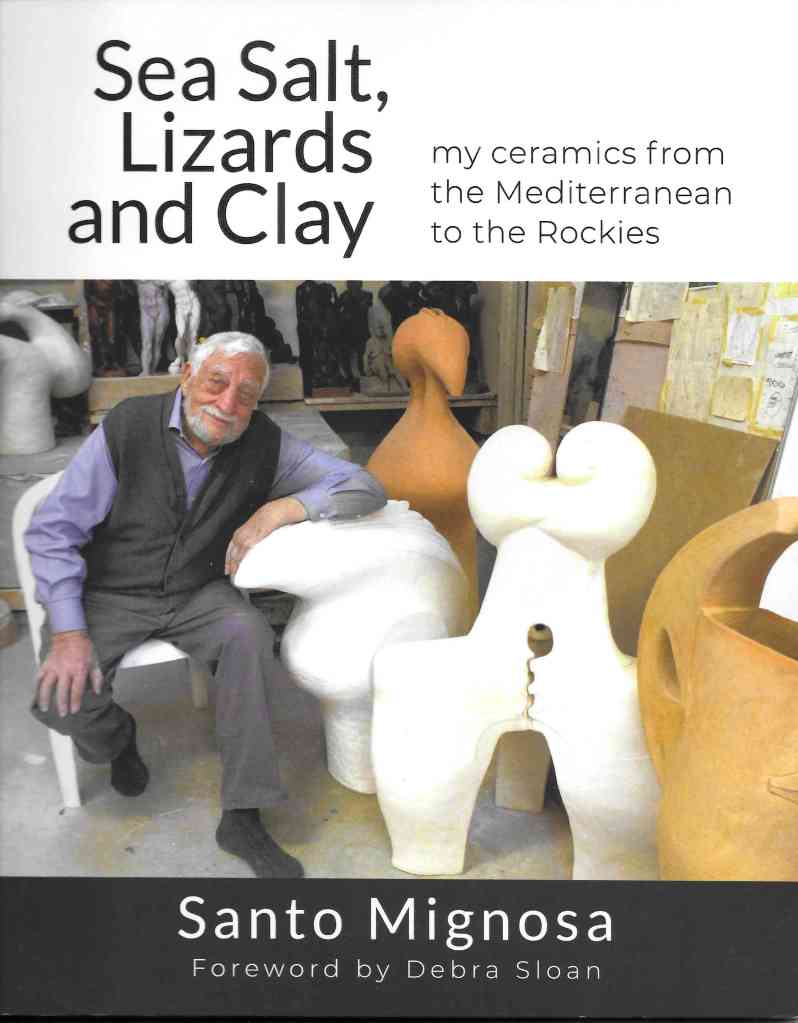
Sea Salt, Lizards and Clay: Santo Mignosa; my ceramics from the Mediterranean to the Rockies.
The internet is a marvellous tool to bring much needed information on publications on ceramists to a wide audience: books such as Sea Salt, Lizards and Clay.
Sea Salt, Lizards and Clayis not just a textual but also an extensive visual autobiography of Santo Mignosa from his earliest days in Sicily, through his studies in Florence, to his many years in Canada, especially BC. I will leave the provocative meaning of the book title to those who read the book.
A foreword by ceramist and historian Debra Sloan sets the context for Mignosa’s place in ceramic history. The meat of book is a much illustrated biography that includes My Story, an Author’s Note and Author Statement. What follows are sections on what may surprise many who know of Mignosa only through his BC pottery. There is so much more to the man with sections on Figurative Sculptures, Abstract Sculptures, Murals, Drawings, and Wheel Throwing, from his earliest years up into his latest life and activities in Aldergrove, BC.
There are recollections from his partner, Susan Gorris, and memories from artists Ken Clarke and Susan Marczak. His detailed curriculum vitae — yes he is an octogenarian artist who maintains an extensive resume of an extensive career — can only hint at the scope of Mignosa’s work in BC and internationally; and of course, of his influence on so many Canadian students and professional potters. The many illustrations of his work give a much needed display of a career that has roots in both the Italian Renaissance and 20th century Modernism.
MIgnosa’s range of ceramic work is impressive both in form and in scale. His functional wares are sturdy and colourful, with overtones of the Leach tradition; but he has also been comfortable throwing large “classical” amphora-style works, well over a metre in height. A favourite sculptural form is his abstract sculptures, frequently with Surrealistic overtones, with, for example, a face emerging from a clay matrix. Others are large vase and cylinder forms capped or enveloped by penetrated and lightly incised mantle- or cape-like extensions. Frequently with raw, unglazed surfaces these can be seen standing like sentinels or massive chess pieces lining a wall of his studio.
Then there are his figurative sculptures, especially the nude as a favoured subject. The influence of his studies in Florence, of the Italian Renaissance and Classical sculpture, are most evident here; and in works such as Springtime there is a nod to Art Deco.
Clay is in the very bone of Santo Mignosa himself. As he says:
“For me, clay is not just a medium through which I create objects. It is an inseparable part of me, a constant companion in which I find comfort, fulfillment and pleasure in its versatility and applications.”
Sea Salt, Lizards and Clay is a needed and welcome addition to the story of ceramics in Canada.
———————————————–
Sea Salt, Lizards and Clay. My ceramics from the Mediterranean to the Rockies. Santo Mignosa. Granville Island Publishing, Vancouver BC. 2020. 126 pages.
ISBN: 9781989467329(softcover). $25.95 CAD, $20.95 USD. Available via your local bookstore, or Amazon.ca ISBN: 9781989467275 (hardcover). $45.95 CAD, $40.95 USD. Please contact the Publisher for this version.
For over forty years they have been a mainstay of Nova Scotia pottery. Although their work displays their individual interests and talents, it is always recognizable as their distinctive brand, Birdsall-Worthington pottery. Their earthenware works reach across many genres including functional, commemorative and jewellry.
Enjoy their story and let them know how much you appreciate their art and contribution to Canadian studio ceramics.










 Studio Ceramics Canada